

How To Prepare for Your Trip to Peru
- 23 May, 2026
- by Oliver Eberlein
Preparing for Peru — book early, pack for diverse climates, bring cash & cards, plan for altitude, get travel insurance and stay healthy & safe.
Read more

Peru is a country defined by its rich, vibrant history and fascinating culture. Whether it’s your first time visiting or you’re looking for new ways to experience the country, brushing up on Peruvian culture and traditions will help you make the most of your vacation.
Before you pack your bags, here’s our insightful introduction to the culture, traditions, and beliefs that influence how Peruvians live their lives.
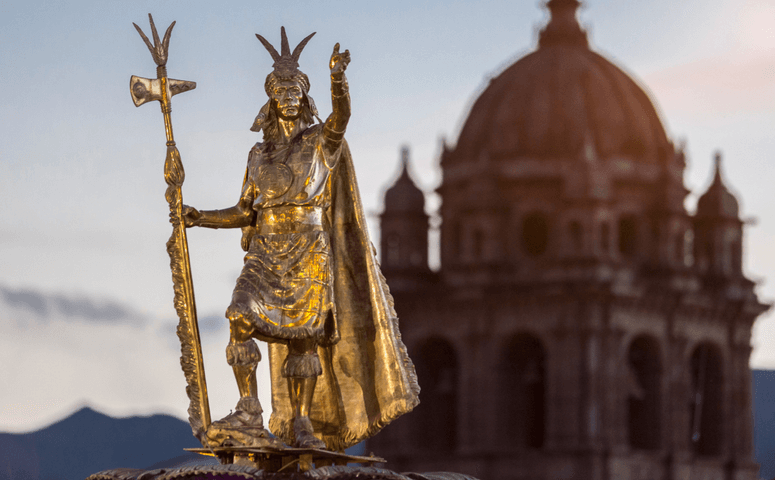
Evidence of human presence in Peru (such as hunting tools) dates all the way back to 13,000 BC (or approximately 15,000 years ago). In the decades that followed, the settlers began to farm more intensively and grow crops such as cotton, potatoes, and corn. They also domesticated animals such as alpacas, guinea pigs, and llamas and used them for fur and meat.
As settlements started growing in the Andean mountains and along the coast, so did archaeological civilizations such as the Cupisnique (1,000 BC to 200 BC), Chavin (1,500 BC to 300 BC), and Wari (600 AD and 1,100 AD).
In the 15th century, the Inca became one of the most powerful civilizations in the Peruvian region and established the biggest pre-Columbian empire in South America. Along with building archaeological wonders such as Machu Picchu, they established a strategically located capital (Cusco) that is still one of the most beautiful and economically significant cities in Peru.
In the year 1532, Spanish soldiers led by Francisco Pizarro conquered Peru, making the end of the Inca Empire. In 1821, José de San Martín proclaimed Peru’s independence, though parts of the country remained under the ruling of the Spanish crown. In 1826, under the guidance of Simón Bolívar, the last Spanish troops surrendered.
The ancient Inca were known to be polytheists – worshiping several different gods. Among the most important ones were Inti (the sun god), Mama Quilla (the moon goddess), and Illapa (god of thunder).

Throughout Peru’s modern history, Roman Catholicism has played a substantial role. Today – although there is freedom of religious choice in Peru – most Peruvians (74.6%) follow the Christian religion introduced by the Spanish. Of those, 60% identify as Catholic and 11.1% identify as Evangelical. Of the remaining population, 3% identify with other religions, 4% identify with no religion, and 21.1% are unspecified.
The official national language of Peru is Spanish. Quechua and Aymara are the second and third most commonly spoken languages, so they both have official status.
All of these languages are a reflection of how historical events have shaped Peruvian society. Indigenous tongues are still being spoken in many parts of the country, but because Spanish is the most common language in Peru, learning a few simple Spanish phrases will likely come in handy when traveling the country, especially in smaller towns and villages.
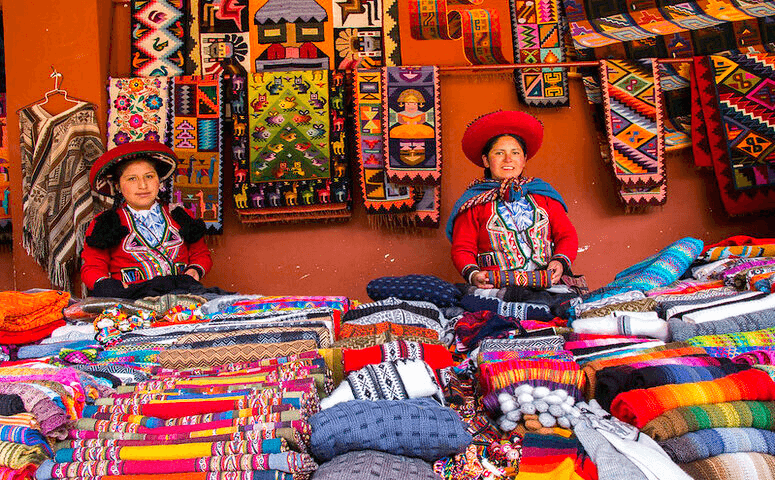
Traditional Peruvian clothing has been used for centuries as means to communicate status, celebrate important events, and show unity. While each region in Peru has its own identity, the customs that are deeply rooted in its people and the stunning mixture of colors expressed through their clothing continue to stand out.
Let’s look at a few vibrant examples of traditional Peruvian clothing:
Most Peruvian clothing items are made of wool, an excellent choice when trying to regulate your body temperature in the unpredictable Andean weather. If you’re headed to the jungle, here are some ideas on what to wear in the Amazon Rainforest to ensure a comfortable adventure.
Peru has an incredibly rich culture, traditions, and history, so it comes as no surprise that Peruvian festivals are among the most vibrant and colorful in South America.
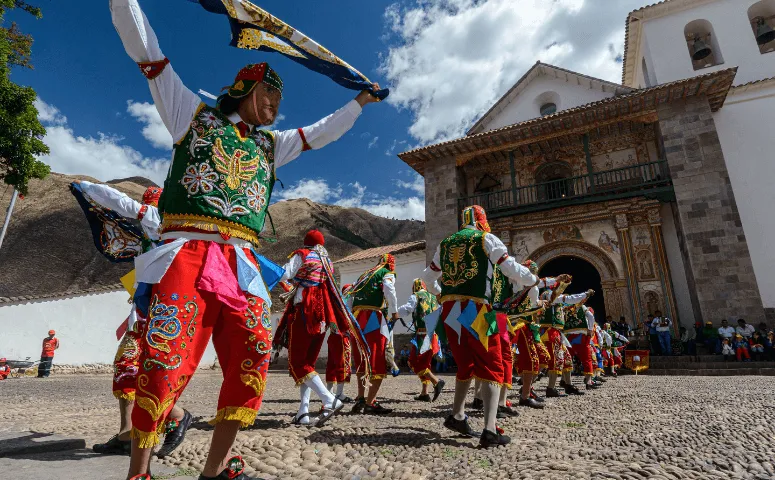
There are thousands of festivals happening across the country every year, and attending one of these celebrations can be a great addition to your Peru trip itinerary. Here are some of the most popular annual festivals in Peru:
Another exciting event worth visiting is the carnival. In the week leading up to Lent (usually in February), the entire country celebrates Peruvian Carnival by bringing together Andean and Catholic traditions, delicious food, and plenty of fun activities such as water balloon fights.
Although Peru’s cuisine has only recently made its way onto the international culinary scene, the nation has a wealthy culinary heritage.
Peruvian cuisine is filled with dishes and flavors you won’t find anywhere else thanks to its agricultural diversity, fresh produce, and unique fusion of cultural influences. Peru’s capital, Lima, is a culinary hotspot and home to a number of world-renowned restaurants that serve traditional Peruvian food prepared with indigenous ingredients along with innovative Peruvian fusion cuisine dishes.

Here are some classic Peruvian dishes you need to try when visiting the country:
Music traditions run deep in Peruvian culture. Throughout history, Peru’s broad musical landscape has developed a beautiful mix of Andean, African, and European influences.
Some of the more commonly used instruments in Peruvian music include antara (traditional Andean panpipe), pinkillo (flute), cajón (box-shaped percussion instrument), and charango (a small stringed instrument that resembles a guitar).

Huayno is among the most popular traditional Andean music and dance genres in Peru. Originating high in the Andean mountains, huayno has been formed by indigenous Quechua and Aymara people. Huayno is best characterized by high-pitched vocals, instruments such as flutes, and traditional dance.
Today, Cumbia is one of the most beloved music styles in Peru. This dance-oriented music originated in Colombia but is hugely popular throughout the entire continent, inspiring a number of sub-genres such as cumbia piurana and cumbia sanjuanera.
Other favored genres you’ll likely hear in Peru include American 80’s rock, chicha (Andean tropical music), salsa, and reggaeton.
Over the years, Peruvians of all walks of life have been able to shape the country’s culture and even influence the world through literature, innovation, entertainment, and so much more.
Perhaps the best-known Peruvian is Mario Vargas Llosa. Llosa is a writer, politician, and journalist that has written across a wide array of literary genres, including literary criticism and journalism. In 2010, he was awarded a Nobel Prize in Literature for his “trenchant images of the individual’s resistance, revolt, and defeat.”
Another well-known Peruvian is Mario Testino – a fashion and portrait photographer whose work has appeared in some of the world’s most popular magazines including Vogue, Vanity Fair, and V Magazine. He has collaborated with a number of famous people such as Princess Diana, Kate Moss, Giselle Bundchen, and Catherine Zeta-Jones, among others.
Sofia Mulanovich is a Peruvian-born surfer and environmental activist. She grew up in Punta Hermosa – one of Peru’s top surfing spots – and is best known for being a 3-time World Surfing Champion and the first Peruvian to win a World League Championship Tour event. In 2007, Sofia was featured in the Surfing Hall of Fame in Huntington Beach, California.
In a country as vast and diverse as Peru, it’s hard to pick just a few highlights. There are, however, certain activities and experiences that need to be on any adventurer’s bucket list.

Let’s take a look at some of the most favored sites in Peru:
From sky-high Inca ruins to the lush-green jungle, Peru has plenty to offer.
How about a Peru tour to discover the country’s incredible cultural legacies, biodiversity, and gastronomy? If you’d like us to help you with your itinerary, feel free to send us an email to [email protected].
Peruvian culture stands out because it combines strong Indigenous roots with Spanish colonial history, African heritage, and Asian migration. Quechua and Aymara traditions remain visible in language, textiles, music, and rituals, especially in the Andes. At the same time, Catholic holidays, European customs, and global influences shape family life, education, and public events. This mix creates a culture that feels both ancient and modern at the same time.
Peru has three broad cultural regions, the coast, the Andes, and the Amazon. On the coast, urban life, Spanish influence, and Afro-Peruvian music and food are common. In the Andes, Indigenous communities keep traditional dress, markets, weaving, and Quechua or Aymara language alive. In the Amazon, many Indigenous groups maintain their own customs, beliefs, and close ties to the rainforest. Each region has its own music, food, festivals, and daily habits.
Some of the most important Peruvian festivals include Inti Raymi in Cusco, a winter solstice celebration that honors the sun, and Carnaval, which features parades, water fights, and colorful costumes in many cities. Holy Week and various Catholic processions bring large crowds into the streets, often mixed with Indigenous symbols and rituals. Local patron saint festivals and harvest celebrations also play a major role in village and city life.
Many Peruvians, especially in the Andes, honor Pachamama, or Mother Earth, through daily habits and rituals. People may pour a small offering of drink or food on the ground before eating, as a sign of thanks. In some communities, farmers hold ceremonies before planting and harvest, asking for protection and a good yield. This respect for nature also appears in music, stories, and community rules about shared land and water.
Peruvian food reflects the country’s diverse history and geography. Coastal dishes like ceviche use fresh Pacific seafood and citrus, while Andean meals rely on potatoes, corn, quinoa, and guinea pig or alpaca. Chinese migration influenced dishes such as lomo saltado and arroz chaufa, and Japanese migration helped shape modern ceviche and seafood recipes. The mix of Indigenous ingredients and immigrant techniques makes Peruvian cuisine a key expression of national identity.

Jake Myers8 September, 2022 at 7:40 am
Really impressive. I didn’t realized that Peru has such a rich and interesting history.
Can’t wait to do the best of cusco in four days tour with you.
See you soon
Jake
Konsti from Exploor Peru9 September, 2022 at 1:51 am
Hello Jake,
Peru is truly incredible and I am sure that you’ll enjoy your time with us.
The Best of Cusco in 4 Days tour is an amazing choice and one of our bestseller.
Feel free to reach out to me if you have any questions or if you need additional input.
Best,
Konstantin